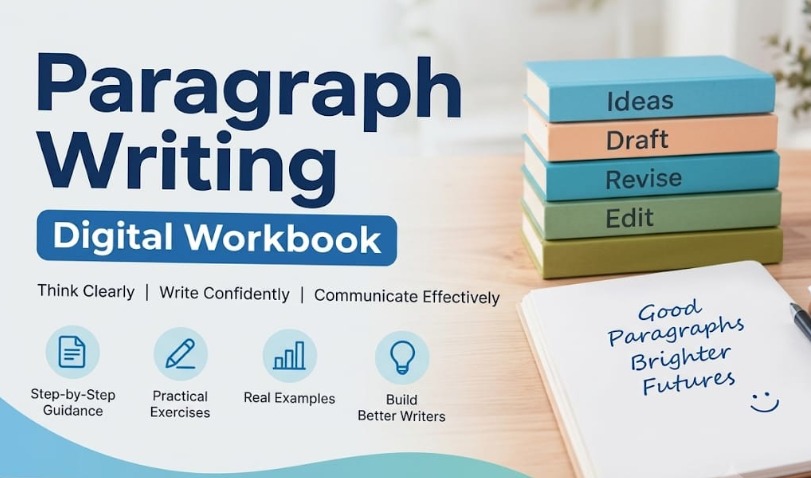
Paragraph Writing Digital Workbookurse

Uncategorized
Wishlist Share

About Course

Paragraph Writing Digital Workbook is an interactive digital learning resource designed to help students develop essential paragraph writing skills through guided lessons, examples, practice activities, and writing assignments.

What Will You Learn?

  • After completing this course, students will be able to:
  • Identify and use four types of sentences: simple, compound, complex, and compound-complex sentences.
  • Apply the six steps of the writing process: choosing a topic, gathering ideas, organizing, writing, reviewing, and revising.
  • Use pre-writing techniques to develop ideas, including listing, free-writing, and mapping.
  • Select an appropriate topic and develop relevant ideas for paragraph writing.
  • Edit and refine ideas developed through listing, free-writing, and mapping.
  • Identify and apply the three basic parts of a paragraph: topic sentence, supporting sentences, and concluding sentence.
  • Write effective concluding sentences and appropriately end a paragraph.
  • Conduct peer editing by identifying weaknesses and providing constructive feedback on a paragraph.
  • Write descriptive paragraphs using appropriate adjectives and descriptive details.
  • Write process paragraphs using appropriate transition words to present steps in a logical sequence.
  • Distinguish between facts and opinions and write effective opinion paragraphs using modal auxiliaries and cause-and-effect connectors.
  • Write comparison and contrast paragraphs using appropriate comparison and contrast expressions.
  • Organize comparison and contrast paragraphs using block and point-by-point methods.
  • Write narrative paragraphs using appropriate components and time transition words to present events logically.
  • Produce clear, organized, coherent, and grammatically appropriate paragraphs through drafting, revising, editing, and proofreading.

Course Content

SIMPLE AND COMPOUND SENTENCES
In this topic, students learn the two basic sentence types: simple and compound sentences

  • SIMPLE SENTENCE
  • Compound Sentence
  • Simple and Compound Sentences

COMPLEX AND COMPOUND-COMPLEX SENTENCES
In this topic, students learn the two basic sentence types: complex and compound-complex sentences

Writing Process
Writing is an essential language skill that enables people to communicate ideas, opinions, experiences, and information effectively. Unlike speaking, writing requires careful planning and thoughtful organization to produce a clear and meaningful message.

Brainstorming
After completing this lesson, students are able to: explain what pre-writing is; choose an appropriate topic for a paragraph; generate ideas using listing, free-writing, and mapping.

THE STRUCTURE OF A PARAGRAPH
in this step, the students learn about the paragraph structure

Peer Editing
In this lesson, students learn about peer editing and how to give constructive feedback on their classmates’ writing. Students will practice identifying strengths, giving positive and specific suggestions, and improving paragraph content, organization, word choice, details, and sentence structure.

Descriptive paragraph
In this lesson, students learn how to write a descriptive paragraph by describing a person, place, or thing using clear and specific details. Students will learn how to use sensory language, descriptive adjectives, and prepositions of location to create a clear picture for the reader.

Process Paragraph
In this lesson, students learn how to write a process paragraph by presenting clear steps in a logical order. Students will learn how to use transition words, imperatives, and expressions for giving advice to explain a process clearly.

Opinion Paragraph
In this lesson, students learn how to write an opinion paragraph by expressing a clear opinion and supporting it with relevant reasons and details. Students will learn how to use opinion expressions, supporting ideas, transition words, and a concluding sentence to develop their opinions clearly.

A comparison and contrast paragraph
In this lesson, students learn how to write a comparison and contrast paragraph by identifying similarities and differences between two subjects. Students will learn how to organize their ideas clearly and use comparison and contrast transition words to develop an effective paragraph.

Narrative Paragraph
In this lesson, students learn how to write a narrative paragraph by telling a story or describing an experience in chronological order. Students will learn how to organize events clearly, use appropriate transition words and past-tense verbs, and include specific details, feelings, and reactions to make their stories engaging.

FINAL EXAMINATION

Student Ratings & Reviews

No Review Yet
No Review Yet